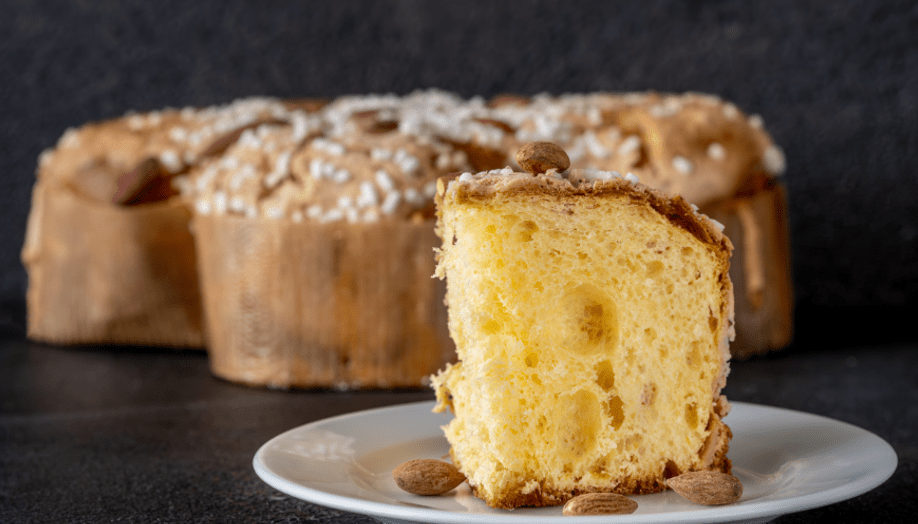
Easter holds a special place in the hearts and homes of Italians, marked by a tapestry of traditions that reflect the country’s rich cultural heritage. Among the myriad customs observed during this sacred season, the Colomba di Pasqua, or Easter Dove, emerges as a quintessential culinary delight, revered for its distinctive shape, delicate texture, and rich symbolism.
Origins
There are many stories about the roots of the Colomba di Pasqua.
Some trace the Colomba back to ancient Rome, where the dove symbolized peace, purity, and renewal – a fitting emblem for the Easter season. Early Christians are thought to have adopted this imagery, associating the dove with the Holy Spirit and the resurrection of Christ. Over time, the dove-shaped cake became intertwined with Easter celebrations, evolving into the Colomba di Pasqua as we know it today.
Another popular legend attributes the creation of the Colomba di Pasqua to the Lombard Queen Theodolinda in the 7th century. According to this tale, when St. Columbanus and his followers travelled to Lombardy in 612 AD, Queen Theodolinda, organised a lavish meal for them. However, they refused the meat as they were partaking in lent, thus offending Queen Theodolinda. In order to make amends St. Columbanus offered to eat the meat only after blessing them. He raised his right hand making the sign of the cross over the meat, and the meat dishes transformed into white dove-shaped breads, thus, the Colomba di Pasqua was born.
Or, as another legend holds the Colomba can be traced to the 6th century, when the Lombard King Alboin lay siege to the city of Pavia. After three years, the people of Pavia in an attempt to pacify the King offered his sweet bread in the form of a dove. The King is said to have loved the bread so much that he then spare the city and its inhabitants.
One final legend, traces the origins back to the 1176 battle of Legnano, when the Lombard League triumphed over Frederick I Barbarossa. The appearance of three doves on the battlefield was interpreted as a good omen by the Lombards. An extended version of this legend, says that the Lombard leader, after seeing these doves, ordered dove-shaped sweet bread to be made for the troops as encouragement.
The actual story of the origins of the Colomba, however, are a little less legendary. Its conception in the early 1930s is owed to Angelo Motta, the founder of the food company Motta, and Dino Villani, the Director of Marketing for the company. In an attempt to continue the productivity of the Panettone-making machines after the Christmas season, they devised a new dessert for the Spring using the same machines and mixture, thus the Colomba was born. Since then, the Colomba di Pasqua, has stood as an iconic symbol of Italian Easter celebrations.
Cultural and Religious Significance
Despite its recent origins, the Colomba di Pasqua holds profound cultural significance in Italy, serving as a focal point for family gatherings, religious observances, and communal celebrations. In many households, the preparation of the Colomba is a cherished tradition, passed down through generations with meticulous care and attention to detail.

In addition to its cultural significance, the Colomba holds profound religious symbolism, serving as a tangible expression of faith and devotion. The dove-shaped cake not only pays homage to the biblical narrative of Christ’s resurrection but also reflects deeper theological truths. Just as the dove brought an olive branch to Noah’s ark, signalling the end of the flood and the dawn of a new era, so too does the Colomba di Pasqua herald the arrival of Easter, a season of hope, redemption, and reconciliation.
Moreover, the act of breaking bread together – a central ritual in the consumption of the Colomba di Pasqua – mirrors the Eucharistic banquet, wherein believers partake of the body and blood of Christ in communion with one another. Thus, the Colomba serves not only as a delectable confection but also as a sacramental sign, uniting individuals in a shared experience of faith and fellowship.
Conclusion
Regardless of its origins, the Colomba occupies a prominent place in Easter celebrations, albeit with some variations and innovations to suit modern tastes and lifestyles. While traditional recipes remain cherished and preserved, many pastry shops and bakeries offer innovative twists on the classic Colomba di Pasqua, incorporating exotic ingredients, artistic decorations, and gourmet fillings to appeal to a diverse range of palates.
Furthermore, the commercialization of Easter has led to the widespread availability of pre-packaged Colomba di Pasqua in supermarkets and convenience stores, making this beloved delicacy accessible to people of all backgrounds and economic means. However, despite these changes, the spirit of tradition and ritual surrounding the Colomba di Pasqua remains intact, serving as a steadfast reminder of Italy’s cultural heritage and religious heritage.
The Colomba now stands as a culinary emblem of Italian Easter tradition. As Italians gather around tables adorned with this iconic Easter cake, they are reminded not only of the resurrection of Christ but also of the enduring power of tradition, community, and faith in shaping their collective identity. The Colomba is more than a cake, it is a testament to the enduring bonds that unite Italians across time and space, making it a cherished symbol of Easter joy and renewal.
 Italy with Amore